LIVE PUBLIC RECORD
·
Updated as new docs surface



NoGoHugo.com presents a fact-based timeline of public statements and documented actions involving Hugo Soto-Martinez and CD13, as they relate to the LACC Swap Meet, community stakeholders, and local residents.
All material is sourced from primary records, screenshots, and publicly available documents. The timeline is maintained as new information becomes available.

Source‑first · Time‑ordered · LACC‑focused

No affiliation with City of LA or LACC Swap Meet
This project focuses on what was actually said, filed, or done, and when. We collect claims, cross‑reference them with permits, emails, public records, and on‑the‑ground reports, and surface a clear timeline anyone can verify.

V E R I F I E D
Every entry is tied to a concrete record: permit, email, photo, video, or public testimony.

C O R R E C T A B L E
If something is wrong, we fix it—backed by receipts, not vibes. See the FAQ for how corrections work.
Each claim is paired with evidence, dates, and links to primary sources where available.
PUBLIC CLAIM #1
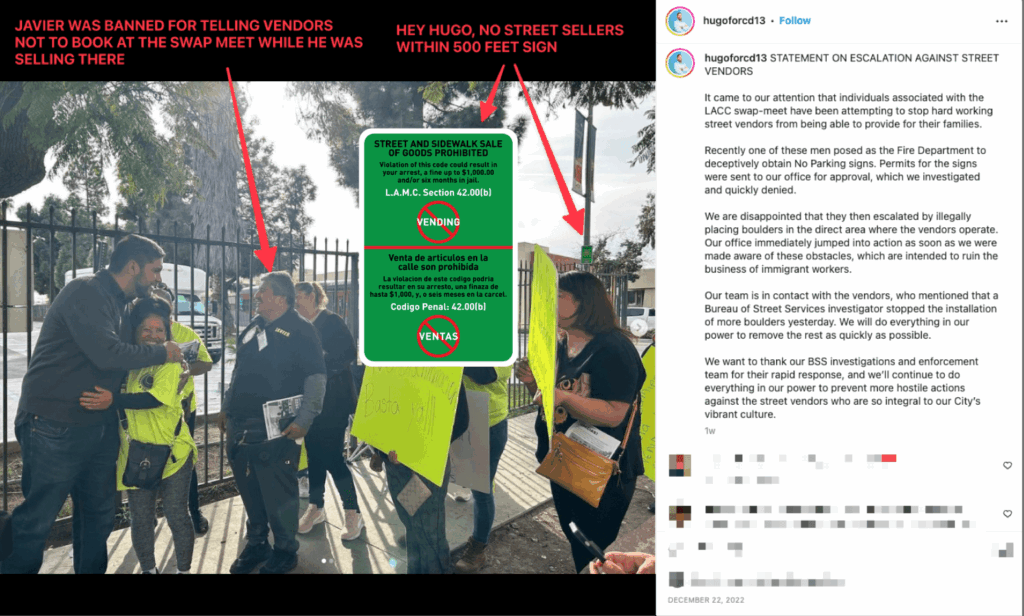
“Individuals associated with the LACC swap-meet have been attempting to stop hard working street vendors from being able to provide for their families.”
FACTS
The LACC Swap Meet operates under existing Los Angeles Municipal Code, including L.A.M.C. §42.00(b), which explicitly prohibits street and sidewalk vending within 500 feet of permitted venues.
Enforcement of existing law does not constitute harassment, targeting, or obstruction of lawful activity.
No evidence is presented in the statement showing illegal conduct by the Swap Meet or its representatives.
STATUS
❌ Unsupported allegation
EVIDENCE PROVIDED IN POST
❌ None
PUBLIC CLAIM #2
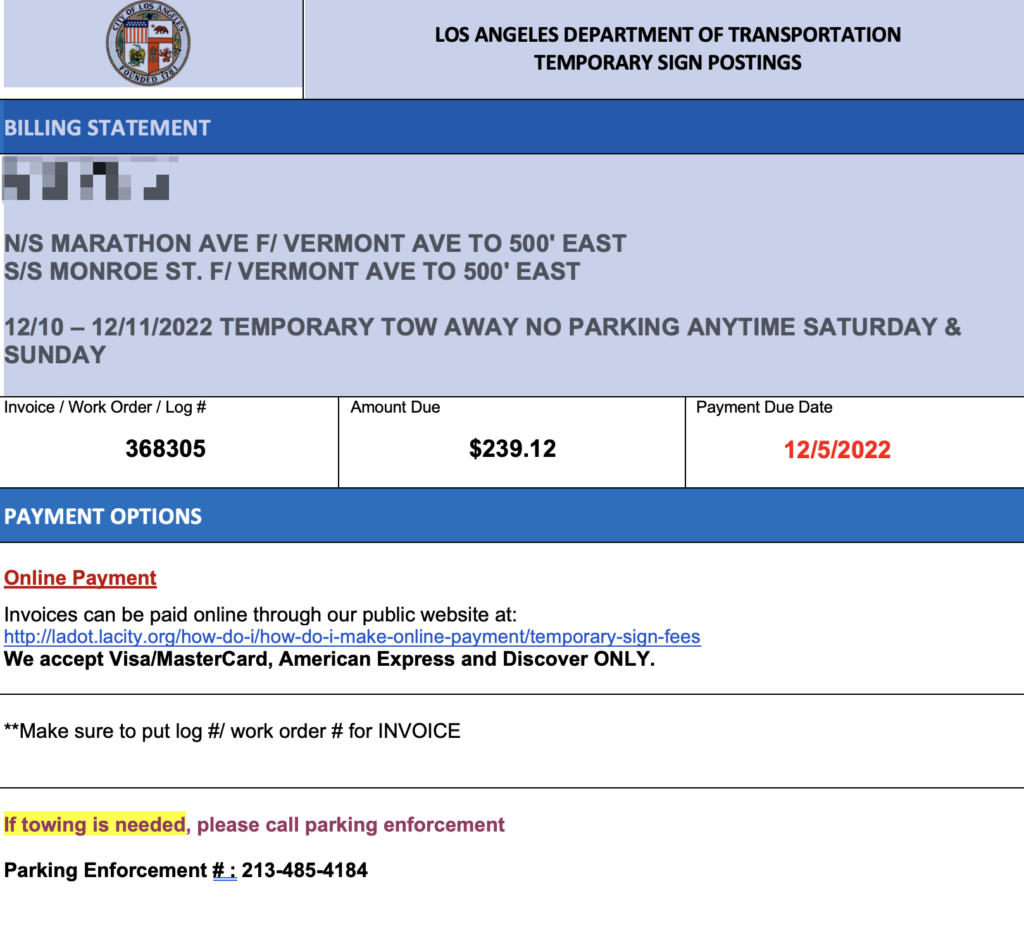
“Permits for the signs were sent to our office for approval, which we investigated and quickly denied.”
FACTS
Parking permits were already lawfully issued and paid for.
The claim implies retroactive authority to deny permits after issuance, which is not supported by City permitting procedure.
No documentation or permit numbers are cited in the statement to substantiate the denial.
STATUS
❌ False
Contradicted by:
Verified identity of LAFD inspector
Valid permits and payment records
PUBLIC CLAIM #3
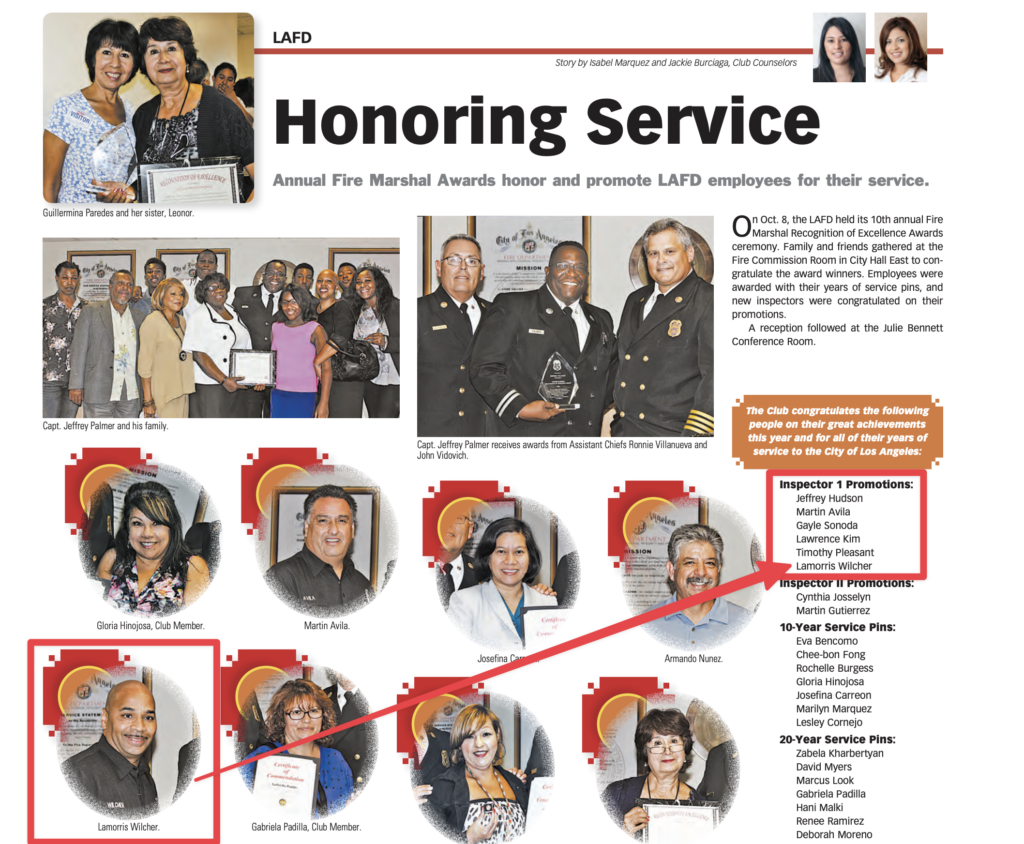
“Recently one of these men posed as the Fire Department to deceptively obtain No Parking signs.”
FACTS
STATUS
❌ Unsubstantiated
EVIDENCE PROVIDED IN POST
❌ None
PUBLIC CLAIM #4
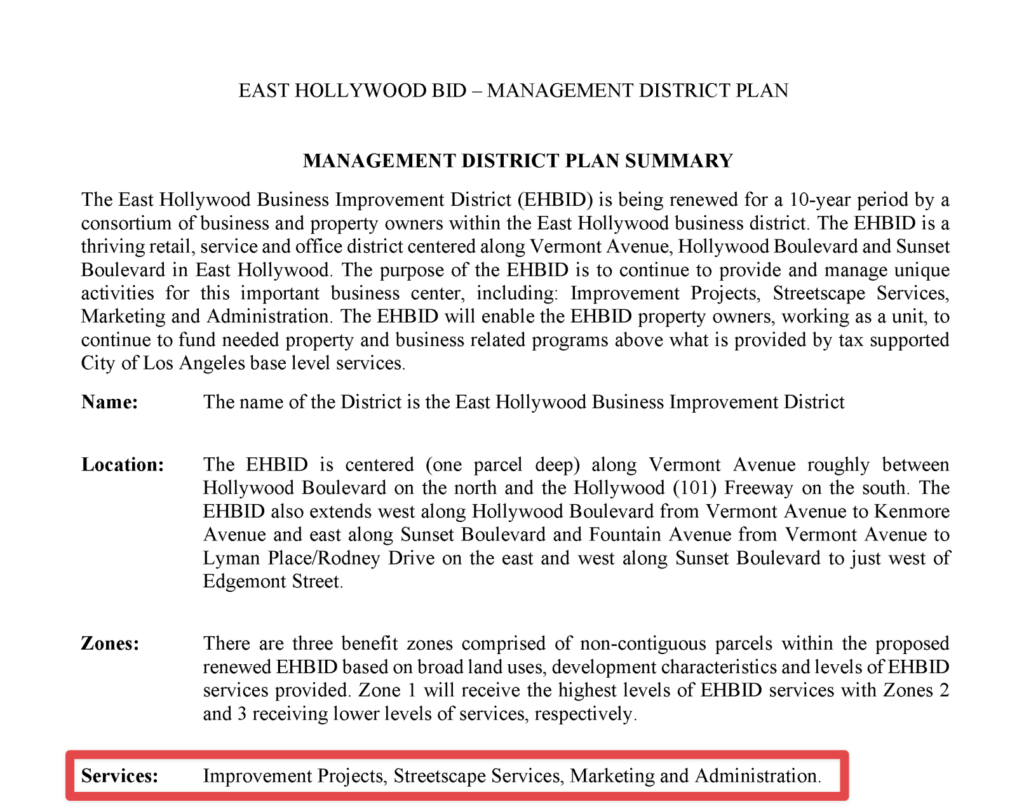
“They then escalated by illegally placing boulders in the direct area where the vendors operate.”
FACTS
The boulders were part of the East Hollywood Business Improvement District beautification project.
Under City authorization, the BID is permitted to place beautification barriers without prior City notification.
The boulders were lawfully placed, permitted, and funded as part of an approved improvement initiative.
STATUS
❌ False
Contradicted by
BID authorization
City-sanctioned beautification rules
PUBLIC CLAIM #5
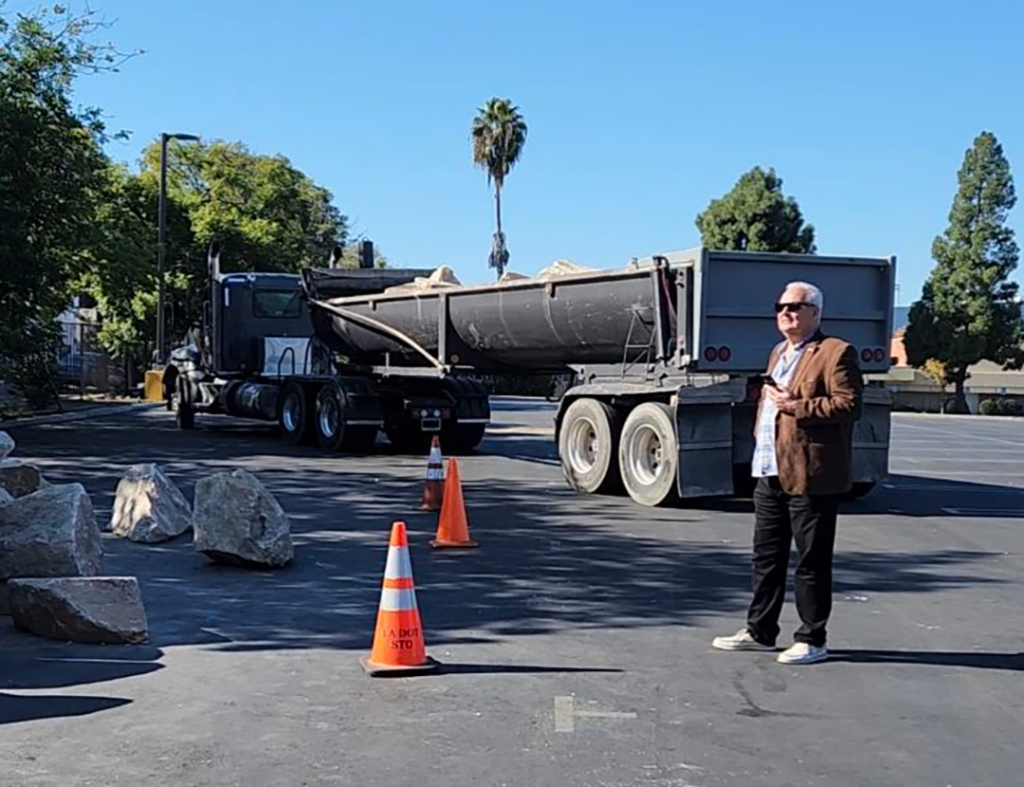
“A Bureau of Street Services investigator stopped the installation of more boulders yesterday… We will do everything in our power to remove the rest as quickly as possible.”
FACTS
The removal of permitted BID property without legal authority constitutes interference with lawful property use.
The removal and seizure of the boulders meets the legal threshold for Grand Theft under California law.
Bureau of Street Services (BSS) intervention violated City law, as the boulders were legally installed and owned by EHBID pictured here is the Chairman of the EHBID.
STATUS
❌ Illegal action described as enforcement
Legal Implication
Potential Grand Theft of permitted property
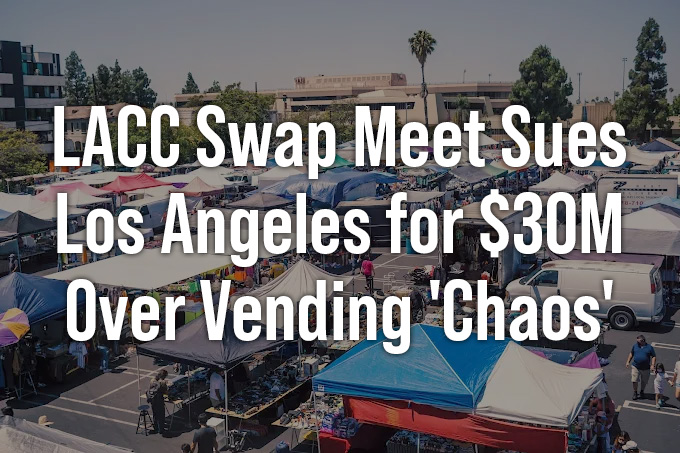
The LACC Swap Meet—a community pillar that has supported student scholarships for decades—has been forced to file a $30 million lawsuit against the City of Los Angeles to save its lawful vendors from ruin. The suit exposes a catastrophic failure of leadership, alleging that the City, led by the “personal vendetta” of Councilmember Hugo Soto-Martinez, has deliberately abandoned rule-abiding businesses in favor of unregulated chaos.
While the Swap Meet pays rent, taxes, and strictly adheres to health codes, the City has allowed hundreds of unregulated vendors to flood the immediate perimeter.
Unfair Playing Field: The City has turned a blind eye to the illegal occupation of sidewalks, allowing outside vendors to operate rent-free and undercut the legitimate, fee-paying merchants inside the market.
Violation of State Law: The suit contends the City is explicitly ignoring SB 946, which mandates a 500-foot no-vending buffer zone around swap meets—a legal protection designed precisely to prevent this kind of economic cannibalization.
The City’s refusal to enforce the law has had devastating consequences:
Revenue decimated by 85%, bringing the market to the brink of closure.
Critical scholarship funds for LACC students are now in jeopardy.
Public Safety Ignored: Requests for basic safety measures, like red zones for fire lanes, were reportedly blocked by Council District 13, prioritizing political ideology over public safety.
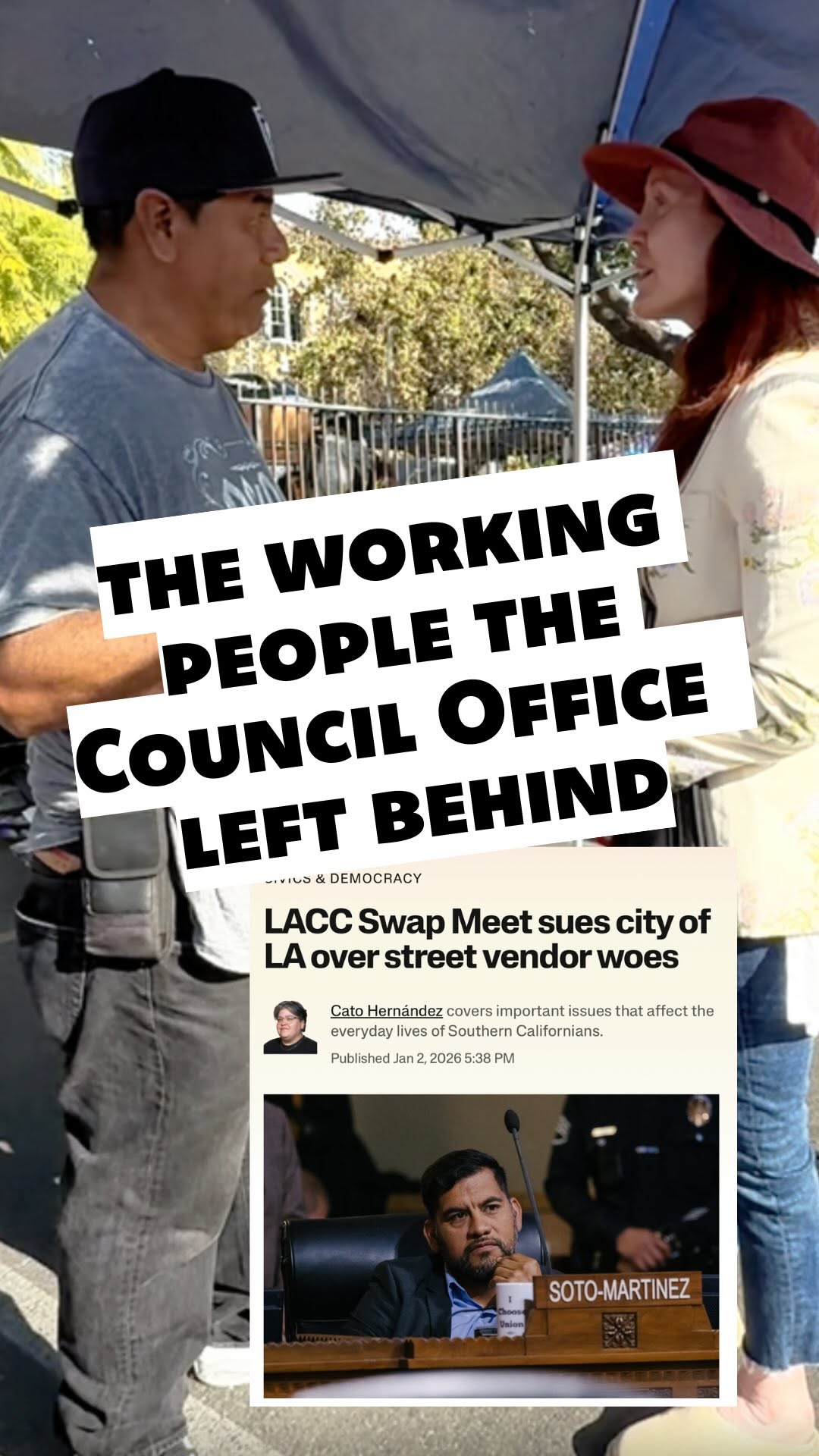
At the LACC Swap Meet in Council District 13, the answer is: working people lose, students lose funding, and the city gets hit with a $30 million lawsuit. And none of this needed to happen.
Legitimate swap meet vendors work hard to thrive every single day—paying their fees, following the rules, and serving our community. They deserve leadership that protects their livelihood, not a system that turns a blind eye to chaos. 
Dylan Kendall breaks down why it is time to stand up for the people trying to make a living the right way.
🗣 The Market Speaks
“We are fighting for the vendors who follow the rules. It is fundamentally unfair for the City to punish lawful small businesses by allowing unregulated competitors to blockade our entrance and destroy our livelihood.” — LACC Swap Meet Leadership
The Bottom Line:
This lawsuit is a stand against administrative negligence, demanding that the City of Los Angeles finally enforce its own laws and protect the established businesses that built this community.
For over three years, vendors and community members have worked tirelessly to save and improve the LACC Swap Meet — a multi‑generational market that:
The problem: illegal street vending & city inaction
Despite state law prohibiting vending within 500 feet of a permitted swap meet, illegal street vendors have taken over the streets surrounding the LACC Swap Meet (Monroe, Marathon, and Madison), creating a dangerous, unregulated marketplace that threatens the safety, fairness, and future of this historic community event.
Instead of enforcing the law, Councilmember Hugo Soto‑Martinez has blocked efforts to regulate the area, allowed illegal vending to continue unchecked, spread false accusations about the swap meet, and refused to meet publicly to address vendors’, students’, and residents’ concerns.
What this negligence looks like on the ground
What vendors are fighting for
Vendors are not anti–street vendor. They support everyone’s right to make a living — but it must be done legally, safely, and ethically.
They are demanding that:
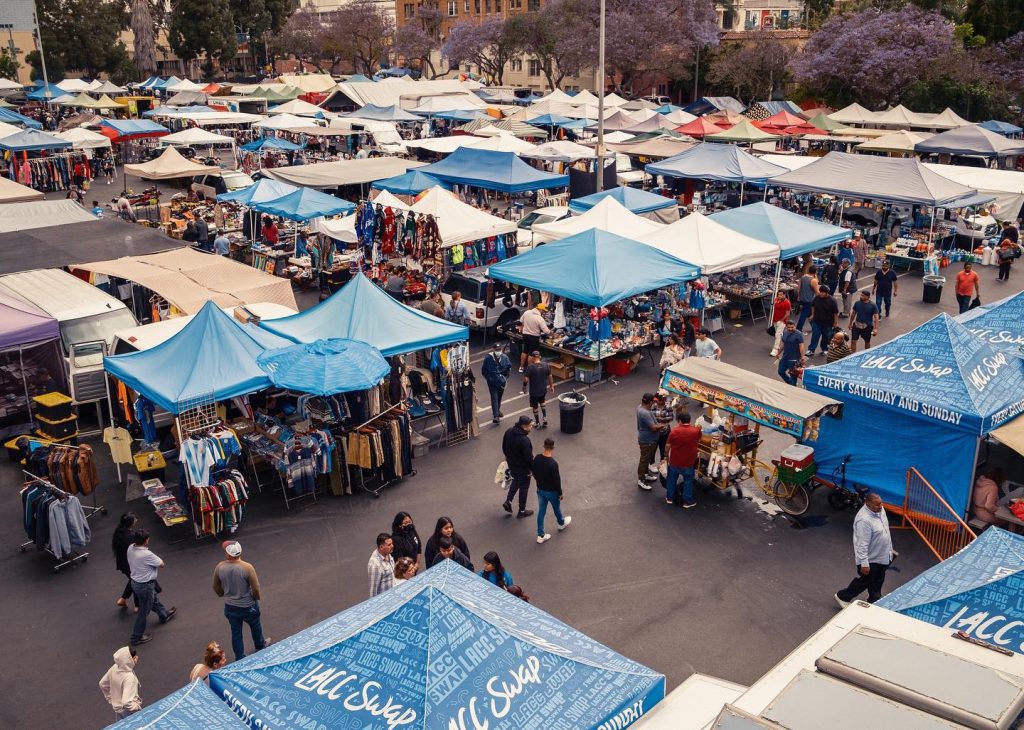
Our community deserves better. Vendors deserve better. The students of LACC deserve better. If we don’t act now, we risk losing this historic market forever.

Stand with over 500 legal vendors fighting for their livelihoods.
Help protect funding for 17,000 LACC students.
Demand the City enforce its own laws fairly and consistently.
Use the contact section below to send your support, testimony, or to request a link to the latest petition that vendors are circulating.
How this fits into the public record
This section summarizes the stated concerns and demands of LACC Swap Meet vendors. Where possible, entries in the main timeline will link to petitions, letters, and public statements referenced here.
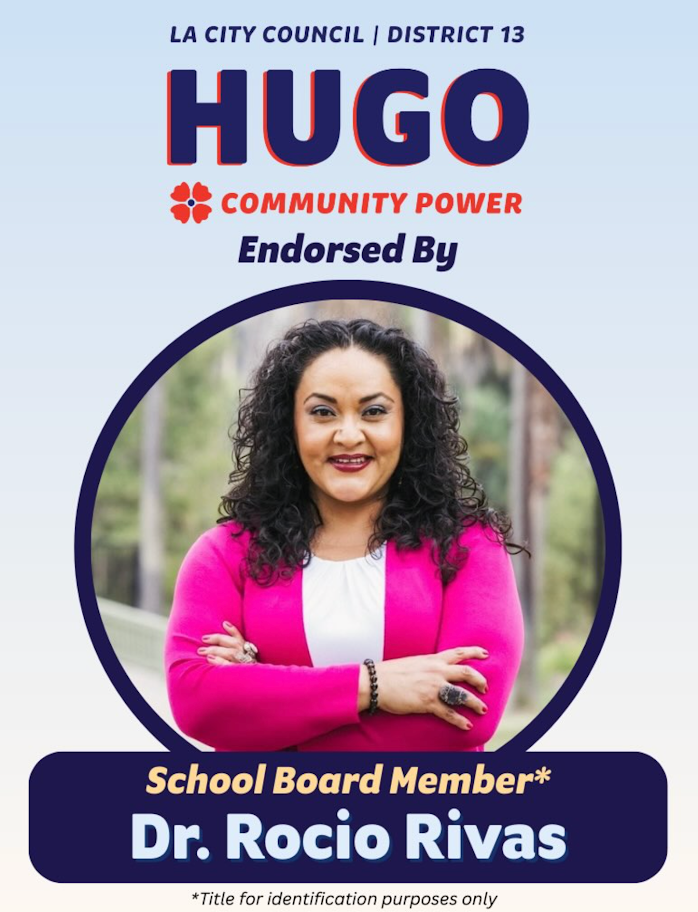
Much of Hugo Soto‑Martinez’s political strength does not come from the people most directly affected by decisions around the LACC Swap Meet, but from large unions and institutional power. These organizations fund mailers, canvassing, and messaging that present him as a champion of working families—even when the record shows serious harm to the very communities they claim to defend.
Who’s backing whom?
Powerful labor and school‑related unions have lined up behind Hugo—not neighborhood vendors, not swap‑meet workers fighting to keep their stalls open, and not the small businesses squeezed by policy decisions.
Students left behind
Despite this institutional backing, Hugo has been responsible for actions and decisions that cost an estimated 17,000 students access to financial aid —students who relied on that support to stay enrolled, pay bills, and move toward better futures.
Why this matters
When school unions and major labor organizations rally behind a politician whose record includes blocking opportunity and financial aid for thousands of students, there is a clear mismatch between the messaging (“for the kids,” “for education”) and the measurable impact on young people’s lives. This is the hypocrisy of support: institutions get their political ally, while students, vendors, and working families are left to absorb the damage.
17,000 students
While school unions issue endorsements and political mailers, the lived reality for roughly seventeen thousand students is lost grants, interrupted studies, and doors quietly closed on their futures. Those are not abstract numbers—they are individual people whose opportunities were narrowed while powerful institutions claimed to be “standing with” them.

Behind every permit, press release, and talking point are real people trying to live and work in their homes. For many residents around Vermont Ave, Monroe St, and Marathon St, the current situation means chronic noise, unsafe streets, and financial harm weekend after weekend.
The email below comes from an East Hollywood resident who lives at Vermont Ave & Monroe St, describing what their family experiences because of unpermitted sidewalk vendors, amplified sound, and illegal parking that spill out around the swap meet perimeter.
Note on privacy
Identifying details are redacted to protect the resident’s privacy. The substance of the complaint is preserved as written.

Resident testimony · East Hollywood
Addressed to local officials regarding conditions around the LACC Swap Meet.
Hello,
I am a resident in East Hollywood, and I have major concerns regarding the LACC Swap.
I live on the corner of Vermont Ave & Monroe St, and the LACC Swap Meet makes every weekend of my life miserable. The amplified music starts as early as 8 am sometimes. My baby cannot sleep and I cannot complete any work I need to do (I have a part time job working from home on weekends). The excessive illegal parking clogs up the roads and makes it very dangerous for cars and passengers to pass through. Last weekend my car was hit by an illegally parked vendor, and because the person does not have car insurance I am now in a very bad spot financially. A very similar incident occurred with my neighbor a few weeks ago when her car was hit by a street vendor.
To be clear: I do not have an issue with the LACC Swap itself, as they appear to follow the necessary guidelines for safety and respect. It is the illegal vendors on the sidewalks who use amplified sound and make the streets unsafe for cars and pedestrians.
I have reached out directly to the LACC Swap twice now. They claim to have no liability and that all this activity is due to illegal vendors that set up immediately outside the swap along Vermont Ave, Monroe St., and Marathon St.
I deserve a modicum of peace and quiet in my own home, and I am at the end of my rope. Please respond at your earliest convenience, and I look forward to hearing your solutions.
Name redacted
Resident name blacked out to protect identity.

Follow‑up correspondence from same resident
Sent to Phillip Dane and Councilmember Hugo Soto‑Martinez regarding ongoing conditions.
To Phillip Dane
Mr. Dane,
Thank you for your empathy and for taking the time to provide this detailed, helpful information. I sincerely respect all you have done and continue to do for our community. It is extremely unfortunate that the good work of the LACC Swap is overshadowed by the ongoing, blatant disrespect of these outside vendors.
To Councilmember Hugo Soto‑Martinez
Mr. Soto Martinez,
It is extremely disappointing—though not surprising—that an elected official would put his own interests above those of his community. It appears you have been well aware of these concerns for some time, yet refuse to take action to make your community safer. In fact, it appears you are directly preventing any sort of compromise or solution. This is nothing short of a betrayal to your constituents.
To be clear: I have absolutely no problem with street vendors—I patronize them regularly throughout Los Angeles. Street vendors are one of the coolest and most unique things about our city. Everyone has the right to establish a livelihood for themselves and their families. I am a single mother who lives paycheck to paycheck, so I directly relate to and respect anyone who works hard to provide for their family. I am also a public school teacher of 17+ years and currently work at a campus in this community. Public service is an honor, a privilege, and a duty I take seriously.
In theory, if you claim to support street vendors, you would work with them to establish a manner for them to do business legally, safely, and sustainably. In reality, you abuse your position of power to actively violate the law in favor of a highly specific community. It appears you have allowed your own family history (which is sincerely admirable) to completely overshadow any safety concerns of those who do not share your exact background.
Name redacted
Resident name blacked out to protect identity.
Official concerns related to illegal vending outside the LACC Swap
Amplified sound
Due to the illegal use of amplified power that often begins as early as 6 am, my baby and I have NEVER had a peaceful Saturday or Sunday morning. I have a second work‑from‑home job on weekends, and it is virtually impossible to concentrate due to the loud music and sermonizing that occurs (even with the windows closed, the sound is unbearable). Can you imagine if someone was outside your home every single Saturday and Sunday blasting music and proselytizing?
Traffic and parking
The illegal parking of these vendors along Monroe, Madison, and Marathon streets creates extremely precarious if not dangerous conditions. Just last weekend, I was hit while leaving my own home by an illegally parked vendor. Because this vendor did not have car insurance, I am now liable for $734 dollars to repair my vehicle. Again, as someone who lives paycheck to paycheck, this is a devastating financial burden.
Safety of community members
The weekend activity draws a crowd that compromises the safety of residents. There are dozens of people who illegally consume alcohol publicly, loiter directly in front of my building, and sexually harass young women. I was once accosted and then “flashed” by a man in my own parking lot. In addition to the sexual harassment, people regularly take advantage of the crowded sidewalk to sneak in behind residents entering the building to drink alcohol in our lobby and on our roof. More than once, I have witnessed grown men urinating on the building in broad daylight.
I hope that you can have empathy for the stressful and scary conditions this creates for me as a woman and single mother. It is so bad that I do not feel safe leaving my home between the hours of 7 am and 4 pm every single weekend. In your official LA City Council biography, you claim to support women in their fight for anti‑harassment protection. I hope you actually mean that.
To be clear: These events and conditions are a stark contrast to those of Monday through Friday, which are generally quiet and safe. There is a direct correlation between the illegal weekend vending and the lack of safety and respect.
It is imperative you immediately address and establish solutions for the concerns outlined above. This would require you to prevent the illegal amplified sound, establish a system to prevent and enforce illegal parking, and provide some form of professional security or police presence to ensure safer conditions for residents. I believe a compromise is possible.
Another line in your official LA City Council biography says you “invest in systems of care that actually prevent crime.” Again, I hope you mean that. You have a responsibility to your community to make everyone feel safe, and I expect you take that duty seriously.
I am formally requesting a response to these concerns within five business days.
Name redacted
Resident name blacked out to protect identity.
A high‑level overview of how the office has performed on major issues residents consistently raise — based on the same documented record.
This is a citizen‑created summary.
We link to the underlying documents whenever possible—permits, emails, public records, news articles—so you can inspect the evidence yourself.
Homelessness & Encampments
D
Public promises vs. actual reductions in unsheltered homelessness, shelter placements, and encampment conditions in CD13.
Public Safety & Quality of Life
C-
Claims around crime trends, enforcement, and neighborhood safety compared to available data and reports.
Housing & Development
C
Campaign rhetoric on affordability and displacement compared with approvals, zoning decisions, and production data.
Ethics, Transparency & Access
D+
Pledges to openness and reform vs. actual practices around meetings, conflict disclosures, and responsiveness.
Constituent Services
C+
What residents report about responsiveness, case work, and follow‑up across neighborhoods.
Broken Promises Log
F
A running list of specific commitments that remain unfulfilled or reversed after taking office.
Elections + representation in CD13
“Bloc” behavior on Council: CD13 is often discussed as part of a progressive/DSA-endorsed cluster of councilmembers (commonly grouped with Raman/Hernandez in coverage), which can shape votes and negotiations when margins are tight. [LA Times]
How people experience it in CD13: supporters feel like their side finally has a “machine” that competes with old LA power structures; critics feel like a highly organized faction can outmuscle less organized neighborhood groups.
Housing + rent stabilization (huge in CD13)
Democracy angle (the critique vs defense):
Defense: stabilizing rent reduces displacement → keeps communities intact and politically engaged.
Critique: opponents argue it discourages new investment/housing supply → longer-term affordability and trust in government suffers. [The Wall Street Journal] [Politico]
Homelessness policy + street-level interventions
How people experience it in CD13: more visible outreach + more visible conflict (encampments, cleanups, business impacts, neighborhood frustration), all landing in the council office as constituent pressure.
Budget priorities + “public safety” definitions
The DSA-adjacent frame often emphasizes non-police interventions (prevention, housing, services) alongside critiques of traditional policing. In districts like CD13, that becomes a constant political argument: “what counts as safety” and where the money goes.
How people experience it in CD13: if you’re a renter or service-provider, you may see expanded help; if you’re a business owner or resident focused on disorder/crime, you may feel government is mis-prioritizing.
“National issues” entering local governance (polarization effects)
How people experience it in CD13: sharper splits at neighborhood meetings, online community groups, and more “identity + ideology” conflict that spills into local issues.
While Hugo Soto-Martínez consistently leverages his background as the “son of street vendors”—referencing it in LAist, Capital & Main, and official biographies to build emotional credibility—this narrative stands in stark contrast to his actual policy stance. Despite invoking his parents’ hard work, he has positioned himself as the primary advocate for enabling and protecting illegal street vending actions, effectively prioritizing non-compliance under the guise of family history.
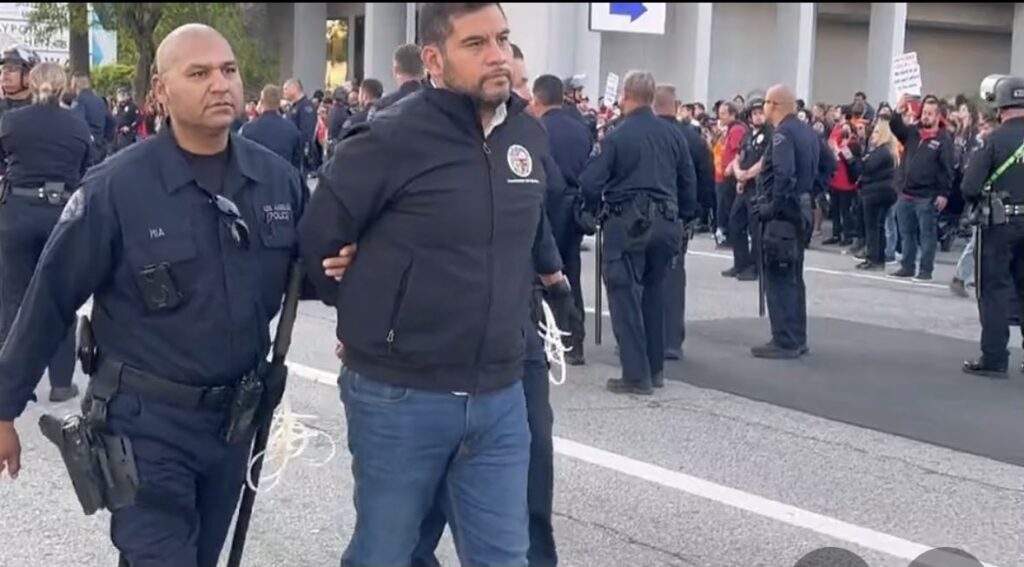
LAist / LA City Council Street Vending Coverage (2023)
We link to the underlying documents whenever possible—permits, emails, public records, news articles—so you can inspect the evidence yourself. [LAist]
Capital & Main (2023)
He’s quoted saying: “Growing up, my parents were street vendors, so I’m emotionally connected to this issue…” — another direct mention. [capitallandmain.com]
L.A. Taco coverage (2023)
The article refers to him as “a son of street vendors…” and quotes him tying his personal background to vending policy. [LA Taco]
CD13 official biography
The Council District 13 “Meet Hugo” bio states he “was born and raised … the proud son of Mexican immigrants and street vendors…” — this is a biography section affirming the family background, though not a verbatim spoken quote. [City Council District 13]
Wikipedia
The Hugo Soto-Martinez Wikipedia entry likewise notes: “Soto-Martinez was born and raised … to two Mexican immigrant parents who worked as street vendors.” — this is a summary reference his family background. [Wikipedia]
Instagram / other social posts
I found an Instagram line reference: “As the son of street vendors…” — unofficial but consistent with public narrative. [instagram]
Source-first
We link to the underlying documents whenever possible—permits, emails, public records, news articles—so you can inspect the evidence yourself.
Time‑ordered
Events are presented chronologically to reduce confusion and cherry‑picking. See how claims and counterclaims evolve over time.
Focused on LACC Swap Meet
Special emphasis on issues impacting vendors, attendees, staff, and the surrounding neighborhood. This is not a general‑purpose political site—it’s about this specific impact.
NoGoHugo.com is an independent documentation project focused on public statements and the real‑world impacts around the LACC Swap Meet.
The goal is not to generate outrage—it’s to provide clear, sourced context. If you believe something here is incorrect, contact us with the supporting record and we’ll review it.
If you see an error:
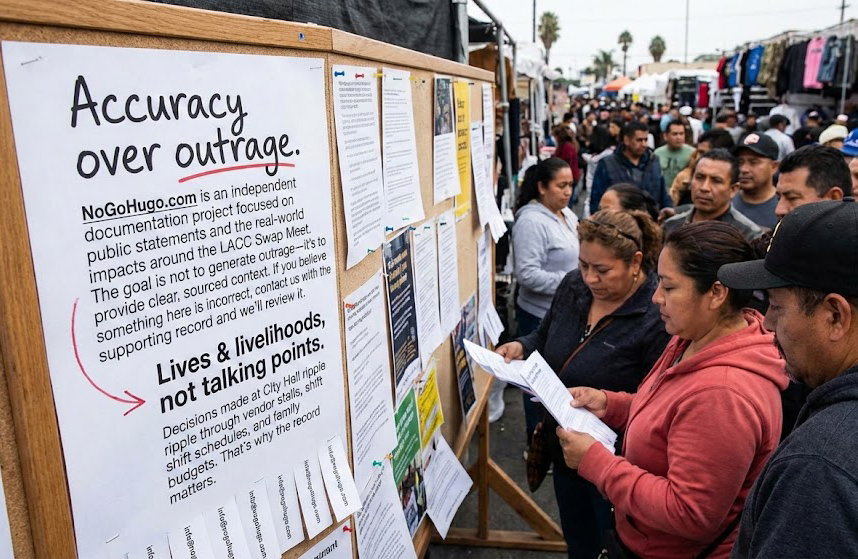
Lives & livelihoods, not talking points.
Decisions made at City Hall ripple through vendor stalls, shift schedules, and family budgets. That’s why the record matters.
To submit a document, request a correction, or share a public record link, reach out below. Please include:
P R I M A R Y C O N T A C T
Email: info@nogohugo.com
For your privacy, remove sensitive personal information from any documents before sending. We focus on public records and official actions.
Use this to draft what you’ll send via email. When you submit, we’ll generate a formatted summary you can paste into your mail client.
No. NoGoHugo.com is not affiliated with the City of Los Angeles, the office of any elected official, or the LACC Swap Meet. It is an independent effort to organize public information and community documentation in one place.
We prioritize primary sources: city documents, DOT permits, fire department communications, emails, public comments, video/audio of meetings, and first‑hand records from impacted vendors and neighbors.
When we reference secondary sources like news articles or social media posts, we aim to link back to the original and capture the surrounding context.
Yes. If you believe something is inaccurate or missing important context, email info@nogohugo.com with:
We review requests based on the available evidence and update entries when warranted, noting significant corrections in the timeline.
Email your submission to info@nogohugo.com with:
Not every submission will appear on the public timeline, but all help us cross‑check the record.
This site is a living record. As new information surfaces, entries may be updated with clearer sourcing and additional context.